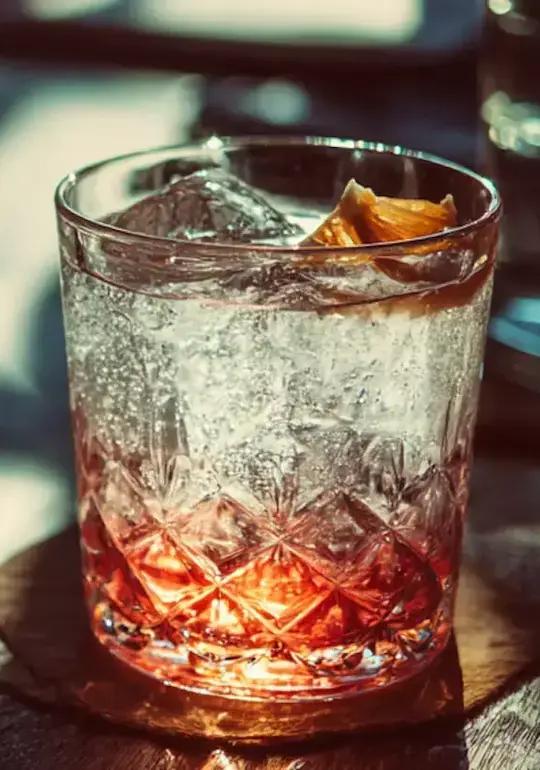
200 years ago, Victor Hugo discovered the Chamonix Valley
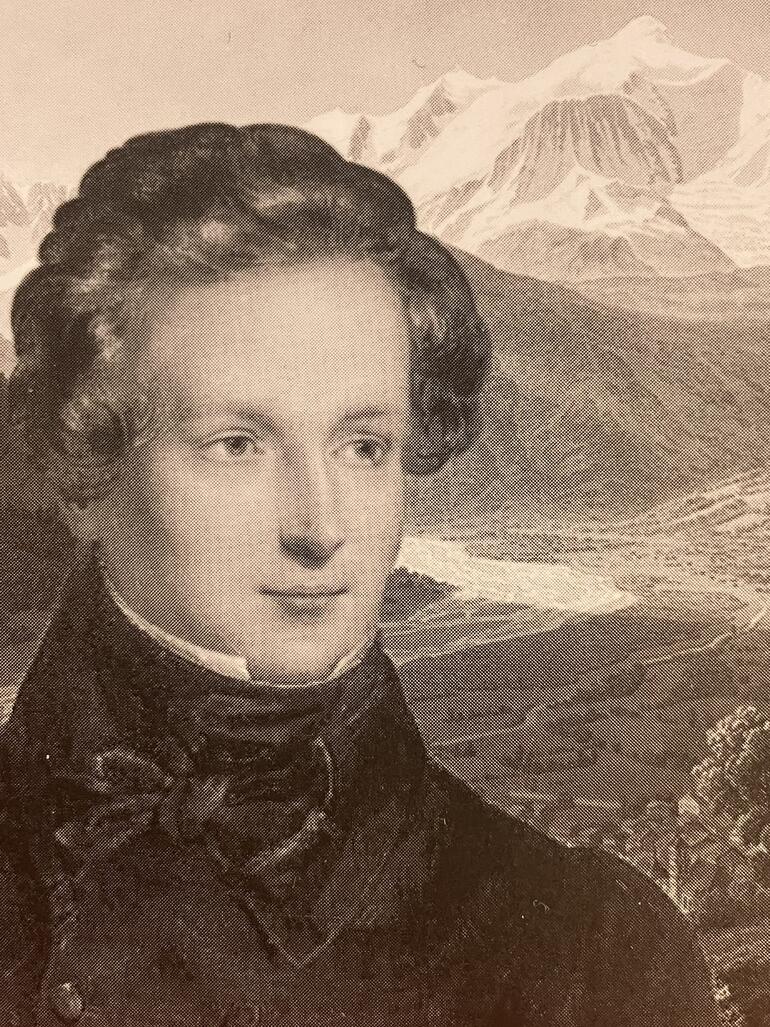
In 1825, during his only stay in the Chamonix Valley, Victor Hugo was just twenty-three years old, but his literary career was already well underway, placing him among the foremost of the new Romantic poets—a group of which he was on the verge of becoming the undisputed leader.
Between August 2 and September 5, 1825, the Hugo and Nodier families traveled from Fontainebleau southward to a retreat near the Alps, at the foot of Mont Blanc; following the alpine accounts of Rousseau, Chateaubriand, Saussure, and Senancour, Victor Hugo, too, took notes, which were first published in the *Revue de Paris* (1829) and then in the *Revue de Deux Mondes* (1831), also under the title *Two Fragments from a Journey to the Alps*.
On August 15, 1825, Victor Hugo arrived in Chamonix. He was traveling with his wife Adèle and their young daughter Léopoldine (then one year old), accompanied by their governess Sophie, the Nodiers, and their daughter Marie.
At the time, the young Hugo—“with his blond hair, his feminine complexion, and the gray canvas suit he wore while traveling”—resembled “a student on vacation.”
The visitors spent three days in Chamonix and stayed at the former Hôtel d’Angleterre, not far from what is now Place des Alpes.
A SCARY MOMENT ON THE MER DE GLACE
No trip to Chamonix is complete without a visit to Montenvers. And no visit to Montenvers is complete without taking a few steps on the ice.
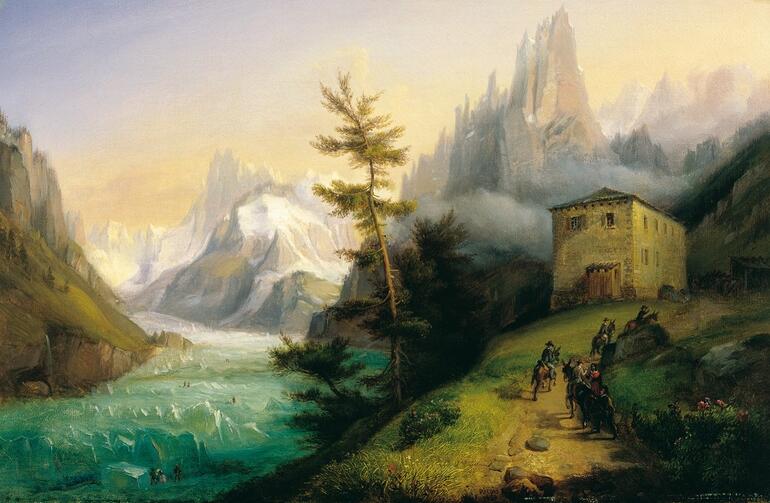
On August 16, 1825, along with his friend Nodier and their respective wives, they hired two guides with their mules to spare the ladies the fatigue of the hike. After a three-hour climb, the small group arrived at Montenvers. While the ladies took refuge in the Temple of Nature, where a guide was selling kirsch-flavored milk, stones, and rock crystals, the future author of *Les Misérables* nearly deprived the world of his iconic literary work by falling into a crevasse!
To cross the glacier, he hired Michel Devouassoux as his guide—a newcomer to the trade—who took the wrong route and led him onto “a narrow ledge between two abysses.” At that time, the glacier was enormous, wide, and heavily crevassed, and there was no regular trail. It was hardly surprising that the young guide made a mistake, but he ultimately kept his cool and brought his client back safe and sound.

Emotions ran high: Nodier, his daughter, Hugo, and his wife vied with one another to provide the most harrowing details in their accounts.
According to the writings, forty years later, by Madame Victor Hugo and the young Marie Nodier:
"[...] The guide took Victor Hugo’s hand and said, ‘Don’t be afraid.’ But he was deathly pale. A short distance away, one of the crevices ended, and the ledge leveled out; but they had to make it that far. There wasn’t room for two side by side: the guide had only one foot on level ground and was walking on the other side along the slippery slope of the chasm; the young mountaineer, for his part, did not flinch and bore the traveler’s weight with the steadiness of a statue.
They reached the ledge, but the danger was not over. The ledge to which the ridge was attached was five to six feet higher than the ridge itself and dropped off sheer.
“‘We must let go of each other’s hands,’ said the guide. ‘Lean on your stick, and close your eyes for fear of vertigo.’”
He climbed up the ice wall, and after a few seconds—which seemed like a quarter of an hour to Mr. Victor Hugo—he leaned over, held out both hands to him, and swiftly lifted him up (…).
Mr. Nodier’s guide, seeing where the other man had come from, realized the reckless mistake he had made and rebuked him harshly: he had endangered the life of a traveler and the honor of his profession… The young guide, so steadfast in the face of the abyss, was less so in the face of the rebuke, and big tears streamed from his eyes (…). Forced to have the traveler attest to the manner in which he had led the tour, Mr. Victor Hugo’s guide therefore had to present his guidebook; he was completely flustered and trembled violently when Victor Hugo returned it to him; his face lit up as he read: “I recommend Michel Devouassoux, who saved my life…”
Victor Hugo did not soon forget this incident. In 1839, in a letter to his wife, he compared the climb he had just completed to that of Montenvers: “… There are travelers who treat the Rigi like Mont Blanc; a sort of Don Quixote of the mountains who are determined to make an ascent and who climb a hill with all the gear of Cachat-the-Giant. Now, the Rigi is very beautiful, but you can walk up and down it with your walking stick in hand. Do you remember, my Adèle, our excursion to Montenvers…?”
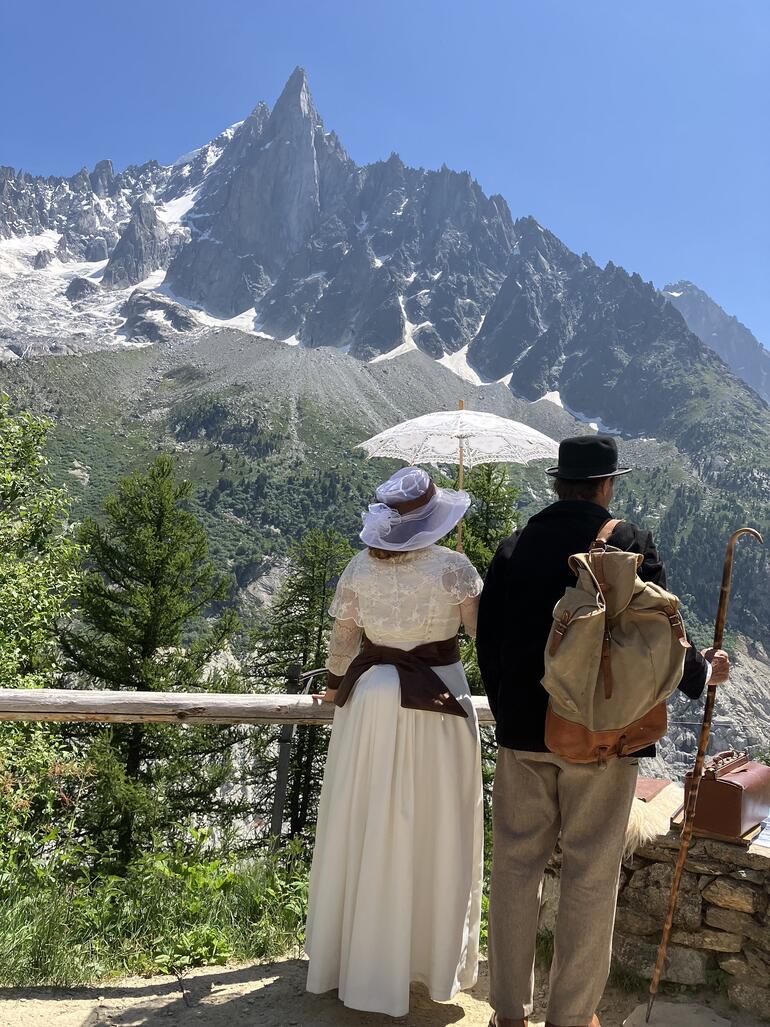
Despite this “big scare,” Victor Hugo enjoyed his discovery of the Chamonix Valley and left us with beautiful descriptions of the landscapes and glaciers, which were rapidly advancing at the time.
“THE CHAMONIX VALLEY IS A TEMPLE” “[…] As you enter the Chamonix Valley, you will feel as though you are stepping […] into nature’s cabinet of curiosities, into a sort of divine laboratory where Providence keeps a sample of all the phenomena of creation in reserve, or rather into a mysterious sanctuary where the elements of the visible world rest.”
THE BOSSONS GLACIER
“Further down, at the edge of an immense bluish mantle that Mont Blanc allows to stretch all the way into the greenery of Chamonix, the jagged outline of the Bossons Glacier (buissons), whose marvelous structure at first seems to offer the eye something incredible and impossible […]. Imagine enormous prisms of ice—white, green, and violet, azure, depending on the ray of sunlight striking them, closely linked to one another, assuming a multitude of varied postures—some tilted, others upright—and setting off their dazzling cones against a backdrop of dark larch trees. It looks like a city of obelisks, cippi, columns, and pyramids—a city of temples and tombs, a palace built by fairies for souls and spirits; and I am not surprised that the ancient inhabitants of these regions often believed they saw supernatural beings flitting among the spires of this glacier at the hour when daylight restores its radiance to the alabaster of their pediments and its colors to the mother-of-pearl of their pilasters. ”
THE MER DE GLACE
“Above this forest, the tip of the Mer de Glace, extending beyond Montanvert like a curving arm, leans and hurls down its marbled boulders, its enormous slabs, its crystal towers, its steel dolmens, its diamond hills, rears its silver walls sheer into the sky, and opens onto the plain this terrifying mouth, from which the Arveyron springs forth like a river, only to die a mile further on like a torrent.”
Bibliography
"Fragments from a JOURNEY TO THE ALPS," Victor Hugo
Colette Cosnier, *Hugo and Mont Blanc*, Guérin Publishers, “La Petite Collection,” Chamonix, 2002, 195 pages.
Christian Mollier, History & Stories: Mer de Glace & Vallée Blanche, Christian Mollier Editions, 2004
A LITERARY NOD 200 YEARS LATER...
The Chamonix-Mont-Blanc Valley Tourist Office wanted to pay tribute to Victor Hugo’s visit by organizing a reading at the iconic Montenvers site.
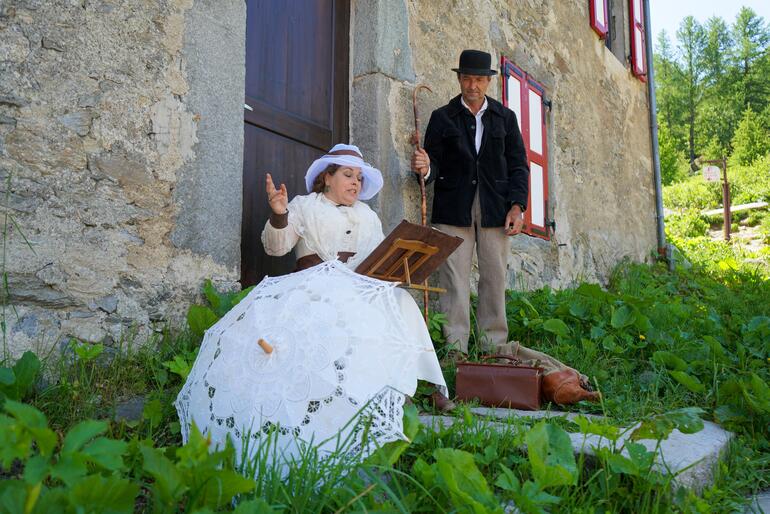
Dressed in period costume and stepping into the shoes of Adèle Hugo, Chamonix actress Mélanie Baxter-Jones skillfully read a selection of texts by the Great Man before an exclusive audience.
High-mountain guide Denis Pivot humorously took on the role of Michel Devouassoux, the guide who once accompanied the future author of *Les Misérables* on the Mer de Glace.
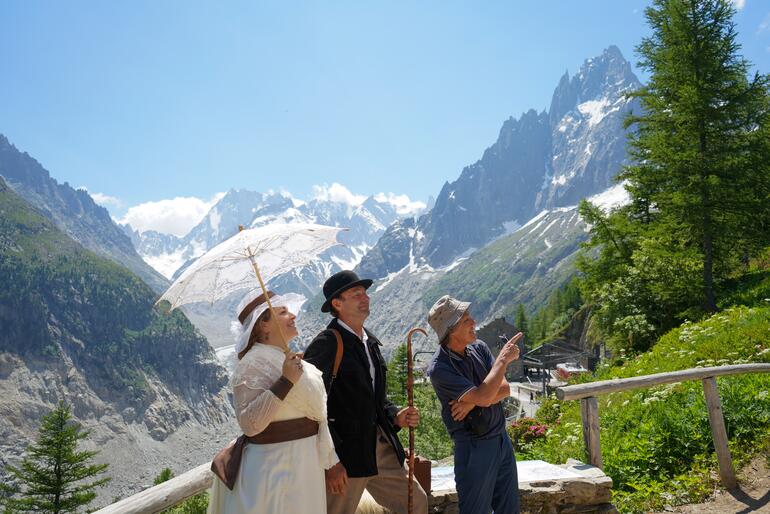
A moment frozen in time, in the presence of Jean-Philippe Gaussot, a descendant of Michel Devouassoux himself!
Here are a few excerpts from the reading...
“In Sallanches, one leaves one’s carriage. From this village to the priory of Chamonix, the journey is made in bench-style carts, drawn by mules, consisting of a single transverse bench where one sits sideways under a sort of small leather canopy, whose four panels can be lowered in case of a storm.
This new way of traveling signals that you are, in a sense, moving from one kind of landscape to another. You are now entering the mountains. The round, flat hooves of horses are no longer suited to these rugged, steep, and slippery paths. The wheels of ordinary carriages would break on these narrow trails, which are constantly torn by rocky outcrops and washed out by torrents. You need light, sturdy carts that can be taken apart at difficult passages and carried across by the guides and muleteers on their shoulders. Until now, you’ve only seen the Alps; now you’re beginning to feel them.
Later, farther on, higher up, you will have to leave even these frail vehicles behind; the untamed terrain of the Alps will drive them back. The sure and bold stride of the mules will carry you for a while longer into these high regions where there is no marked path other than that of the rushing torrent—that is, the shortest route from the mountain’s summit to the bottom of the abyss. You will press on still further, and then vertigo—or some other insurmountable obstacle—will force you to dismount and continue your perilous journey on foot, until at last you reach those places where even man himself is compelled to turn back, those desolate lands of ice, granite, and mist, where the chamois, pursued by the hunter, boldly takes refuge between precipices ready to open up and avalanches ready to fall […]
I realize that my thoughts are racing faster than our swift carriages. We have barely left Sallanches, and already I am trying to make out on the glistening ridges of the ancient Alps the traces not left there by the two great invaders of Italy. For indeed, it is difficult not to feel a deep emotion when, on a beautiful August morning, as we descend the slope on which Sallanches sits, one sees unfolding before one this immense amphitheater of mountains, all diverse in color, shape, height, and aspect—enormous masses, by turns dazzling and somber, green and white, distinct and indistinct—over which a broad ray of sunlight, still slanting, floods every gap, and above which, like the stone of oath in a Druidic circle, Mont Blanc rises majestically with its tiara of ice and its mantle of snow.
Leaving Sallanches, the road to Chamonix crosses a vast plain that gives you plenty of time to admire this grand and unchanging spectacle. This plain, about two leagues wide, had been nothing but a sea the day before. It had rained, and the Arve River, which runs the length of the plain, had taken it all as its bed, as always happens during storms. But twenty-four hours had been enough to force the torrent back within the boundaries it so often breaches; and the road, still muddy as we passed, was now only rarely interrupted by puddles and streams of yellowish water, which occasionally washed over the mules’ hooves and the lower wheels of the bench carts. […]
After laboriously climbing a path littered with rolling stones, which clattered under the mules’ hooves, we passed through the village of Chedde, leaving the beautiful waterfall behind us as we headed deeper into the mountains. Here, for a while, the road is shaded by large oaks, birches, and tall larches, whose branches intertwine and enclose the view beneath a canopy of greenery. Suddenly, the thicket opens and parts as if on purpose, revealing a sight filled with unexpected charm. It is a small lake, which I believe is called Lac Vert because of the thick grass that lines its entire shore, making it resemble a crystal mirror edged with green velvet. This lake, whose waters retain an unchanging clarity, possesses, in the freshness of its appearance and the grace of its contours, something that contrasts delightfully with the somber severity of the mountains amidst which it lies. One might feel as if magically transported to another land, under another sky, were it not for Mont Blanc standing on the horizon with its snow-capped domes, its glaciers, and its formidable peaks—as if jealous of the gentle impressions that dare to arise so close to it, cast its menacing image even into the peaceful waters of Lac Vert.
I do not know by what invisible thread, by what electrical conductor, the things of nature touch the things of art; but at that very moment, those great works of old Shakespeare came to mind, in which a lofty and sombre figure always dominates—a figure that, in a corner of the drama, is reflected in a soul that is limpid, transparent, and pure; works as complete as nature itself, where there is always an Ophelia for Hamlet, a Desdemona for Othello, a Lac Vert for Mont Blanc.
One must not leave the lake without tossing a few coins to the little children of Chedde and Passy, who come to offer passersby glasses of this water so fresh and so beautiful.
The scene changes; the ground is barren, and the greenery disappears around us. The road, blocked by rocks, winds and twists, like a long snake, up the flank of a barren and rugged mountain. We arrive at Nant Noir.
In a deep ravine, where all vegetation seems dead, between two escarpments of iron-rich earth, amid granite boulders that one might mistake for blocks of ebony, black water rushes with a terrifying roar—water so dark that not even its foam can lighten it. This is the Torrent Noir, so named because of the dark color the slate it carries gives its waters, and no doubt also because it is extremely dangerous to cross when swollen by a storm. Everything here is gloomy and desolate. Bare ridges, overhanging rocks; echoes repeating the furious roar of the torrent; not a single tree, save for the veil of dark pines spread out by the mountains on the horizon. In the mind’s eye, there is a world of difference between Lac Vert and Nant Noir.
Many strange legends are told in the region about this hideous torrent. It is said that it was on its banks that the spirits of the Cursed Mountains held their sabbath on winter nights. It was they who uprooted the entire mountain to hide their treasures there. Their tumultuous flight shattered all the trees that once grew in this gloomy place. It was by dancing there that they scorched this land; it was by bathing there that they blackened this water. There is also a demon known as Nant Noir, who pushes travelers into his abyss and laughs as he watches them fall. His eyes are two globes of fire; and more than one daring chamois hunter, lost in the mountains at night, has heard his hoarse, resonant voice echoing from the depths of the abyss in response to the roar of the torrent. […]
Once this torrent is crossed, the ravines become more frequent; the undulations of the road are more abrupt and rapid; the cone of the mountain over which it runs has been, as it were, fluted by torrential rains, landslides, and rock avalanches. However, lush, fresh vegetation reappears along the path, obscuring the view of the Arve, which can be heard rushing at the bottom of the ravine.
A valley with a harsh and somber appearance comes into view. In the middle stands a bell tower, around which a few huts are clustered. This is Servoz. Encircled on all sides by high mountains, this valley seems buried in a white shroud of snow, beneath a black veil of fir trees. What adds to the singularly melancholic impression it makes on the mind is seeing it dominated—or rather, threatened—by the gigantic debris of a mountain that collapsed, I believe, in 1741. It is said that the collapse of this mountain—which crushed forests, filled valleys, and opened up chasms—was accompanied by such a deluge of ash and dust that, for three days, complete darkness shrouded the countryside for several leagues in every direction. Scientists declared it was a volcano. They were mistaken. The uneducated were mistaken as well; they believed it was the end of the world. Of the two errors, I prefer that of the uneducated: it is more naive.
This ruined mountain terrifies the eye and the mind. I do not know—and no one can say—how the center upon which the equilibrium of this great body rested shifted; what cause undermined the foundation upon which its immense terraces, plateaus, domes, slopes, and spires stood. Was it an internal convulsion of the globe? Was it a drop of water slowly dripping for centuries?... Felix qui potuit…
Yet it is difficult not to indulge in futile musings on this great mystery in the face of such a prodigious upheaval. The earth, the snow, and the forests, as they rushed down into the surrounding valleys, have laid bare what might be called the mountain’s skeleton. These blocks of black marble veined with white are its monstrous feet, still half-hidden by pyramidal masses of landslide debris; there are its flint bones, its granite arms still standing tall; and, up there, above the clouds, that broad expanse of limestone, with its horizontal layers laid bare, is the giant’s furrowed brow.
How insignificant man’s monuments seem beside these marvelous structures that a mighty hand raised upon the earth’s surface, and in which there is, for the soul, a kind of new manifestation of God! No matter how much they may change in form and appearance with the passing of the years; their architecture, constantly renewed, eternally retains its original form. These rocks, which tower overhead and crumble away, will be succeeded by other rocks that will pierce the clouds; new trees will grow wild where these trunks, dead from old age, now lie; as these torrents flow, other waterfalls will open up. For centuries, the character of the Alps has remained unchanged. The details pass, but the whole endures. […]
. . . . . . . . . . . . . . . . . . .
We leave Servoz, where we stop for some refreshments, and which marks the halfway point of the journey from Sallanches to Chamonix. Now the path follows the path my mind has just taken; we pass from a collapsed mountain to a ruined castle. For the past quarter of an hour, we’ve been traveling very close to the Arve River, which flows almost at the same level as the road. Suddenly, the mule driver points to the right, toward a sort of high promontory that the neighboring mountain juts out into the middle of the river, a few sections of crumbling walls, along with the remains of towers, narrow pointed arches shaped by human hands, and wide crevices carved by time. This is the manor of Saint-Michel, an ancient fortress of the Counts of Geneva, famous in the region—like the Nant Noir—for the demons that inhabit it and the magical treasures it conceals.
The fearsome palace, the ancient citadel of Aymon and Gérold, stands there, solitary and gloomy like the raven that caws merrily atop its ruins. The blackish ramparts, unevenly weathered by the years, rise barely above the clumps of holly, broom, and brambles that obstruct the moat and the avenue; curtains of ivy have taken the place of the heavy drawbridges and iron portcullises. Above, a forest of larch and fir trees stretches as far as the eye can see; below, the Arve rages, its course obstructed by fragments of granite that have fallen from the cliff bearing the Château de Saint-Michel. One of these boulders, smoothed by the force of the water, blocks the torrent’s flow longer and towers higher over it than all the others.
From time to time, the Arve engulfs it with furious waves, pressing them, rolling them, swelling them, piles them up, and finally surmounts the rock, which remains for a time flooded with all these golden waves, like a head of blond hair; then everything subsides, and, while the roaring Arve launches a new assault, the rock’s face reappears bare and naked.
A bridge comes into view. We return to the left bank of the Arve; and, while our bench-equipped carts follow us with difficulty, we begin to climb the ascents on foot. It is a narrow, steep path, laboriously carved along a terrifying escarpment, to which nothing can be compared except the slope of the mountain bordering the Arve on the other side.
This passage, at times carved into the bare rock, at other times jutting out over an abyss, connects the Servoz Valley to the Chamonix Valley. At every moment, one slips on large granite slabs that make the mules’ hooves sparkle. To the right, the roots of the great larch trees, uprooted by the rains, hang overhead; to the left, one can nudge their tapered tops—sharp as a rock’s needle—with one’s foot. An old woman, feeble-minded and crippled, sitting in a sort of wheeled alcove, stands at the entrance to this perilous road, begging for the pity of passersby. It seemed to me that I was seeing one of those beggar fairies from fairy tales, who waited for an adventurer by the wayside and decided his doom on a refusal or his happiness on a handout.
No sooner have we left the beggar behind than we come upon a cross standing at the edge of the abyss. One must pass quickly by this cross; it signals misfortune and danger.
A little further on, we stop. There is an extraordinary echo there. Long ago, before Dr. Pococke had rediscovered the wonders of this valley of Chamonix—conceded in the 11th century by Aymon, Count of Geneva, to God and to Saint Michael the Archangel—before any human had carved a path across the ridge of this mountain—if, on occasion, a chamois hunter, driven by the fervor of his pursuit all the way into this formidable gorge, reached the very spot where we now stand, he would, trembling with horror, blow the hunting horn hanging from his belt and sound the magical call three times: hi! ha! ho! Three times, a voice would clearly echo back to him from the depths of the horizon with the triple invocation: hi! ha! ho! Then he would flee in terror and go on to tell the story in the valleys that a fairy chamois had lured him beyond the castle of Saint-Michel, and that he had heard the voice of the Spirit of the Cursed Mountains.
Today, in this very same place, elegant travelers and well-dressed women step down from their bench-seated carriages onto a fairly well-paved road. Ragged little boys come running with a long megaphone. They draw high-pitched sounds from it that still resemble the hunter’s ancient incantation. A voice from the mountains still echoes them distinctly, in a softer and more distant tone. And then, if you ask these children, “What is that?” they reply, “It’s the echo,” and hold out their hands. — Where is the poetry?
We leave behind the young beggars, the megaphone, and the source of the echo, and we venture deeper into the gorge, which grows ever narrower and wilder. For a few moments now, a dull gray fog has hidden the sky from us. We climb; it descends. We see it successively fill all the gaps between the opposing ridges. Its edges, which expand and taper off somewhat, resemble the fringe of a net. Whyteish wisps of mist from the Arve rise slowly and join it. It touches the upper edge of the fir trees, envelops them, spreads from tree to tree, and suddenly closes in on us, veiling the mountains in the distance like a curtain lowering over a theater set.
We were at the most terrifying and most beautiful spot along the path, at the highest point of these ascents. Through the mist, we could still make out the opposite escarpment, bristling with fir trees almost lying flat on the ground—so steep is the slope! The rows of the forest are sometimes broken up by large dead trees, which will rot where they have fallen and which could only have been felled by a bolt of lightning from the sky or by an avalanche—that lightning of the mountains. Before us, at the bottom of the dark precipice, we could see the Arve glistening white at such a staggering depth that its terrible roar reached us only as a murmur. At that moment, the cloud parted above us, and this gap revealed, instead of the sky, a chalet, a green meadow, and a few barely visible goats grazing higher than the clouds. I have never experienced anything so extraordinary. At our feet, it looked like a river from hell; above our heads, an island in paradise.
It is pointless to describe this sensation to those who have not felt it; it was a mixture of dream and vertigo.
The Chamonix Valley stretches out before the eyes of the traveler arriving from Sallanches. The winding Arve River cuts straight through it. The three parishes that share its territory—Les Ouches, Chamonix, and Argentière—reveal their gleaming slate bell towers here and there across the narrow plain.
To the left, rising almost vertically above an amphitheater of colorful gardens, chalets, and cultivated fields, the Brévent soars with its forest of fir trees and jagged peaks, around which the wind winds and unwinds the clouds like thread on a spindle. To the right lies Mont Blanc, whose summit makes the ridge of its outline shine vividly against the dark blue of the sky, above the high Taconnaz Glacier and the Aiguille du Midi, which rises with its thousand peaks like a many-headed hydra. Further down, at the edge of an immense bluish mantle that Mont Blanc allows to stretch all the way into the greenery of Chamonix, the jagged outline of the Bossons Glacier (buissons), whose marvelous structure at first seems to offer the eye something incredible and impossible. It is, without a doubt, something richer—and perhaps even more singular—than that strange Celtic monument at Carnac, whose three thousand stones, bizarrely arranged on the plain, are no longer simply stones and are not buildings. Imagine enormous prisms of ice—white, green, and purple, azure, depending on the sun’s rays striking them, closely linked to one another, assuming a multitude of varied postures—some tilted, others standing upright—and their dazzling cones standing out against a backdrop of dark larch trees. It looks like a city of obelisks, cippi, columns, and pyramids—a city of temples and tombs, a palace built by fairies for souls and spirits; and I am not surprised that the ancient inhabitants of these regions often believed they saw supernatural beings flitting among the spires of this glacier at the hour when daylight restores its radiance to the alabaster of their pediments and its colors to the mother-of-pearl of their pilasters.
The day we arrived there was August 15, the Feast of the Assumption. We were descending rapidly down the far side of the mountain, our eyes fixed as if by magic on the magnificent panorama of this valley, finally revealed to our gaze. Suddenly, a bend in the path revealed another sight to us. At our feet, in the green plain, on the slope of the hill that raises the church of Les Ouches above its village, two winding lines of villagers with clasped hands—veiled young women and children—stretched out, led by a few priests and a cross. It was a procession returning from the Priory of Les Ouches, reciting the litanies of Saint Mary, Mother of God. From time to time, the wind carried to us a broken echo of their songs. I cannot say what profound impression it was that, in a way, sealed the feelings that were overwhelming me and made them indelible. I will carry this memory with me for the rest of my life. At that moment, all the sounds of the Alps filled the valley; the Arve raged over its bed of rocks, the torrents roared, the rain-fed waterfalls quivered as they crashed into the depths of the precipices, the gale whipped the clouds in a corner of the Brévent, and the avalanche thundered from the heights of Mont Blanc’s desolate peaks; but, to my soul, none of these formidable voices of the mountains spoke as loudly as the voices of those poor shepherds imploring the name of a virgin.
What power is it that brings forth, on the same day, at the same hour, the pope and the resplendent legion of cardinals from the gilded gates of St. Peter’s in Rome, the royal procession from the magnificent portal of Notre-Dame de Paris, and from their humble presbytery, forgotten in its valley, the humble procession of the mountain folk of Chamonix! What wisdom is that which can, at the very same moment, inspire the same thought in the whole world!
What is remarkable about the valleys of the Alps is that they are, in a sense, self-contained. Each one presents, often within the most confined space, a kind of universe unto itself. They all have their own distinct appearance, shape, light, and sounds. One could almost always sum up the overall effect of their character in a single word. The Sallanches Valley is a theater; the Servoz Valley is a tomb; the Chamonix Valley is a temple.
Beyond the Bossons Glacier, directly across from the Priory of Chamonix, the wooded ridge of Montanvert curves gently; and, higher up, on the same level, appear the two peaks of Les Pèlerins and Les Charmoz, which resemble those magnificent medieval cathedrals, all adorned with towers and turrets, lanterns, spires, steeples, and pinnacles, and between which the Pèlerins Glacier spreads its undulations, like curls of white hair on the mountain’s gray head. The background of the scene fittingly completes this magnificent ensemble. The eye, which never tires of wandering across all the levels of this vast mountainous edifice, finds subjects of admiration everywhere. First comes a forest of gigantic larch trees that carpets the opposite end of the valley.
Above this forest, the tip of the Mer de Glace, extending beyond Montanvert like a curving arm, leans forward and hurls its marbled boulders— its enormous slabs, its crystal towers, its steel dolmens, its diamond hills, rears its silver walls sheer into the sky, and opens onto the plain this terrifying chasm, from which the Arveyron springs forth like a river, only to die a mile further on as a torrent.
Behind the Mer de Glace, towering over everything around it, rises the Dru, a granite pyramid formed from a single block fifteen hundred toises high. The horizon, against which one can barely make out the Col de Balme and the rocks of the Tête-Noire, is crowned by a jagged chain of snow-capped peaks, against whose whiteness this prodigious obelisk of the Dru stands out, isolated and grayish. When the sky is clear, with its tapered shape and dark color, one might mistake it for the solitary bell tower of some ruined church; and one might think that the avalanches that occasionally break away from its walls are doves swooping down upon its deserted friezes. On a rainy day, when one glimpses it indistinctly through the fog, one imagines seeing Virgil’s Cyclops seated within the mountain, and the white waves of the Mer de Glace are the flocks he counts as they pass at his feet.
Add to this landscape of wonders the eternal presence of Mont Blanc, one of the three highest mountains on the globe, and that sense of grandeur that every great thing imparts to its surroundings; meditate on this summit, which is truly—to borrow the poets’ fable-like expression—one of the ends of the earth; consider this striking concentration, within such a confined space, of so many unique sights, and you will believe, as you enter the Chamonix Valley, that you are stepping […] into nature’s cabinet of curiosities, into a sort of divine laboratory where Providence keeps in reserve a sample of all the phenomena of creation, or rather into a mysterious sanctuary where the elements of the visible world rest.
Excerpts from “Fragments of a JOURNEY TO THE ALPS,” Victor Hugo
Latest articles Our Inspirations

Events You Won't Want to Miss This Fall

The Top 3 Activities to Try as a Family This Fall

Frankenstein on the Mer de Glace

The Incredible Story of Jacques Balmat's Alpine Stick

The New Mont Blanc Museum in Chamonix

"Alpine portraits" webserie
The One and Only Cie des Guides de Chamonix