The Incredible Story of Jacques Balmat's Alpine Stick

On August 8, 1786, at 6:23 p.m., two men from Chamonix—Jacques Balmat (a farmer, crystal finder, and chamois hunter) and Michel-Gabriel Paccard (a medical doctor)—became the first to reach the summit of Mont Blanc.
A landmark achievement in the history of mountaineering!
At the time, their equipment was rudimentary: no ice axes, no crampons on their boots... Each of the two mountaineers carried a long wooden pole nearly 3 meters long, tipped with a metal spike.
This indispensable tool helped them make their way both on the ascent and the descent, and served multiple purposes: a pole for jumping over crevasses, a probe for testing snow bridges, a bridge for crossing crevasses, and a means of descending using the “witch’s descent” technique.
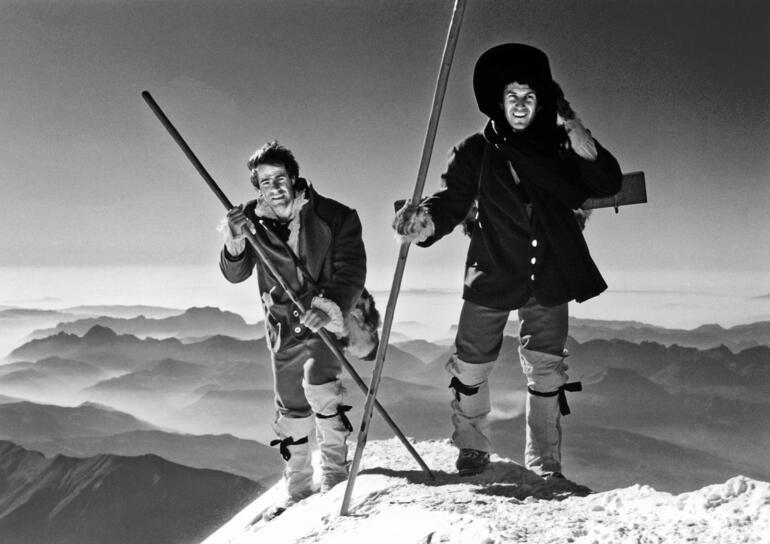
Jacques Mottin and Jacques Cuenot - 1986, the Bicentennial of Mont Blanc © Jean Blanchard
After completing five ascents of Mont Blanc, Jacques Balmat—known as “Mont Blanc,” who became the first guide of the Chamonix Guides’ Company (and in history!)—preferred to roam the mountains in search of game and crystals.
He disappeared in September 1834, at the age of 72, while searching for gold on Mont Ruant, and his body was never found.
Since his historic ascent, he must have worn out several walking sticks, but he had never brought himself to part with the one that had accompanied him for the first time to the summit of the Roof of Europe.
Upon his death, his estate was sold at auction, and a carpenter from Les Houches, Jean Méril Payot, purchased the hiking pole. Once he returned home, he realized that the metal ferrule was damaged and turned to the blacksmith of the time, Pierre Devouassoud, to have the damaged tip repaired.
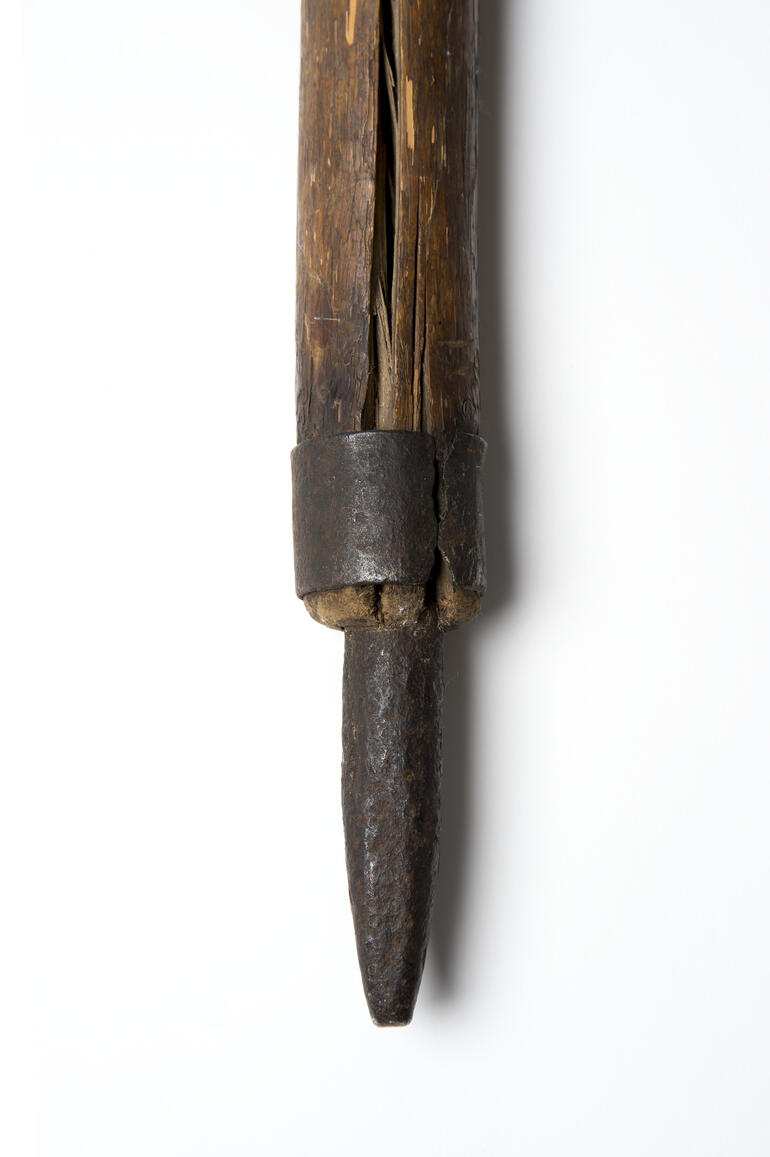
Pierre Devouassoud was well-educated. His father and three uncles were renowned guides who had participated in the second ascent of Mont Blanc in 1787, alongside De Saussure and Jacques Balmat. His cousin had even married Dr. Paccard’s daughter. When he learned of the staff’s origin, he understood its significance and offered to exchange it for a new one. Deal done!
Pierre Devouassoud died in 1861, and his son Michel inherited the blacksmith shop and the famous relic.
In August 1878, Jean Méril Payot’s two sons—who had become mountain guides—asked Michel Devouassoud to lend them the staff for the unveiling of the memorial dedicated to Jacques Balmat (which now stands in front of the Maison de la Montagne in Chamonix).
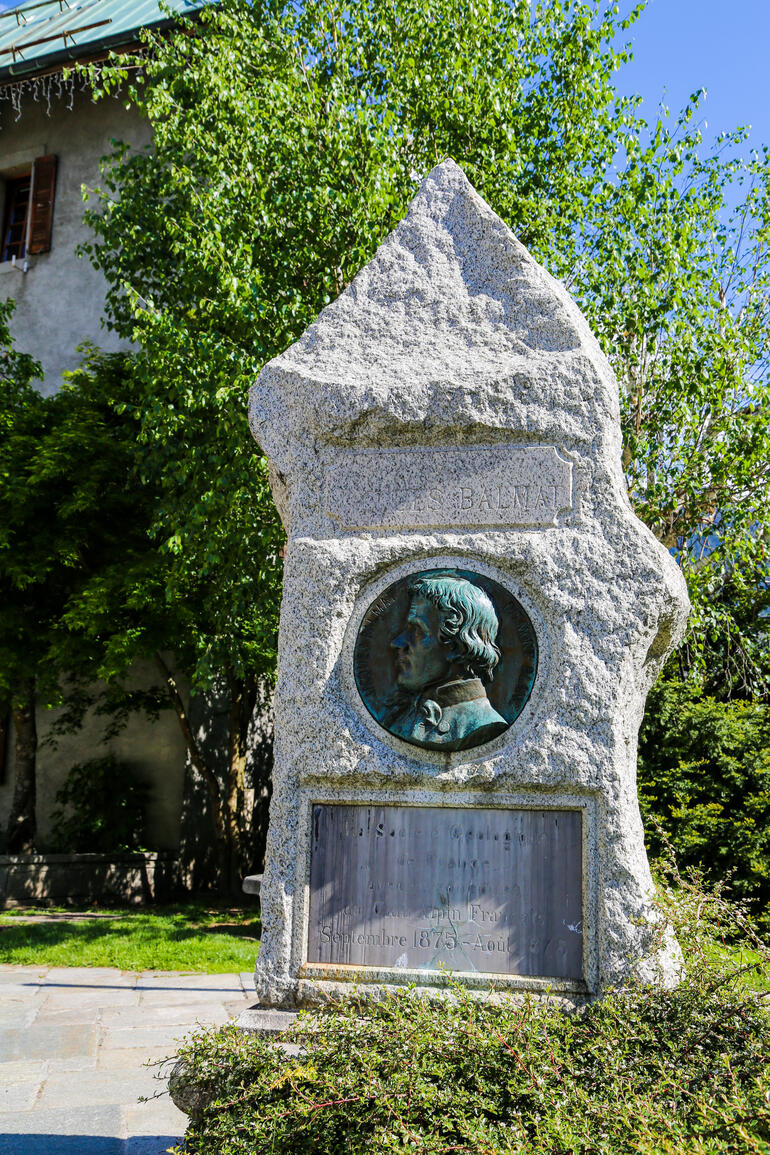
In 1886, on the centennial of the first ascent of Mont Blanc, Michel Devouassoud recognized the historical significance of this staff, and since Jean Méril Payot was still alive, he asked him for a document certifying its authenticity. The signature was authenticated by the mayor of Les Houches at the time.
In August 1887, the staff was once again loaned out for the unveiling of the statue commemorating the centennial of Saussure’s ascent.
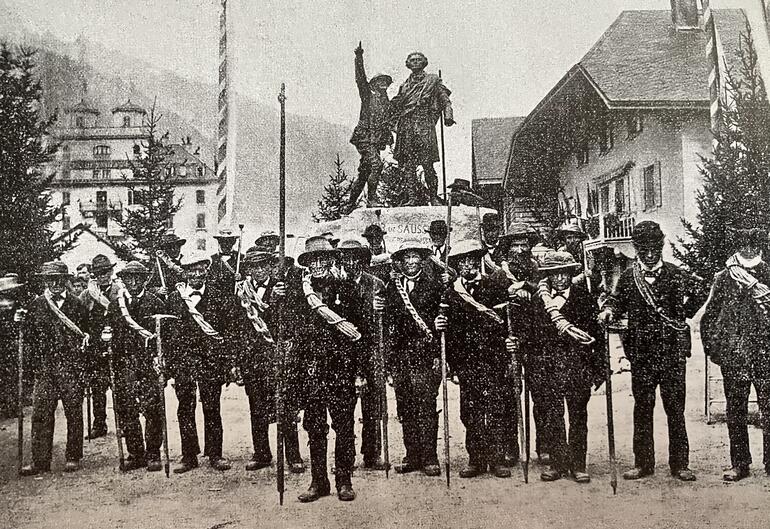
The authenticated walking stick then remained in the Devouassoud workshop, and the secret was passed down from generation to generation.
In 1986, during the bicentennial ceremonies marking the first ascent, no one claimed it. Gérard Devouassoud decided to deposit the certificate of authenticity in a bank.
In 1996, following the Arve River floods, the vault was submerged and the official document was damaged! Fortunately, Gérard had made a copy.
Upon Gérard’s death in 2015, his son Thomas became the sixth guardian of the stick and the secret.
In 2017, Denis Pivot—a high-mountain guide, professor at ENSA (National School of Skiing and Mountaineering), and enthusiast of the history of mountaineering equipment—was preparing a book on ice axe manufacturers.
He met Thomas, and the two enthusiasts became friends. One day, Thomas revealed the existence of this alpine stick to him, and Denis couldn’t believe his eyes! He was holding in his hands “the tool that symbolizes the birth of mountaineering.”
After a meticulous investigation, he had no further doubts: all the clues and evidence pointed in the same direction—this pole was indeed the one used on the first ascent!
Denis suggested to Thomas and his family that they display Balmat’s walking stick at the Alpine Museum in Chamonix.
And so, the precious artifact was unveiled to the public on December 11, 2018, on International Mountain Day.
The pole is now on display in a showcase atthe newMont Blanc Museum ( ).
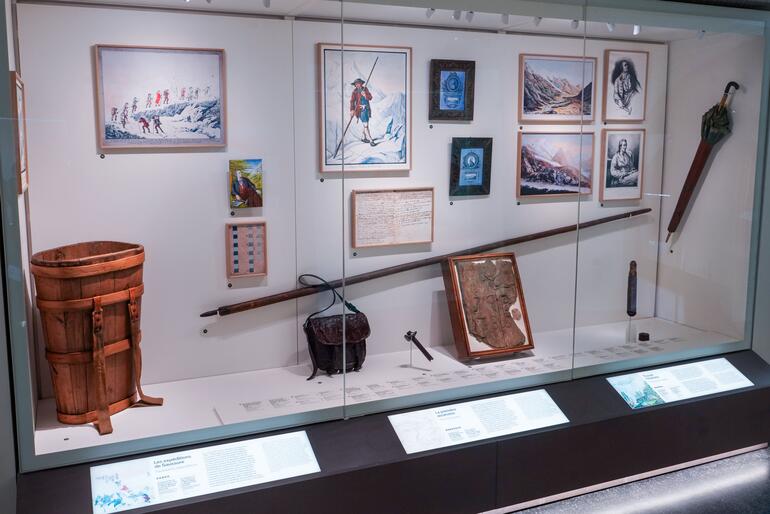
What’s extraordinary is that the only mountain walking stick from that era to have survived to this day is Jacques Balmat’s!
THANK YOU and CONGRATULATIONS, Denis Pivot!!!
Bibliography
*Les Pellarins*, by Maurice Gay and Marie-France Balmat
*Des Piolets et des Hommes*, by Denis Pivot